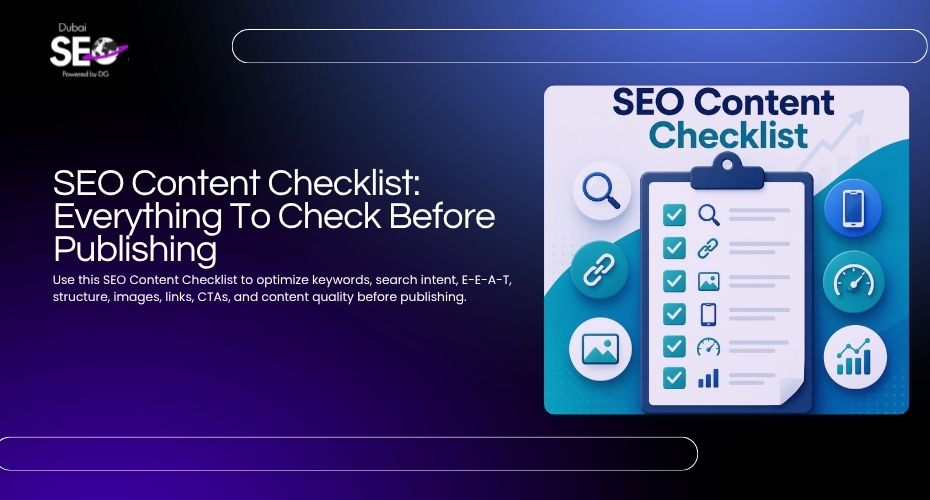





SEO Checklist for Blog Posts: 15 Tips to Optimize Your Website

April 28, 2026
Do you know that a complete SEO checklist for blog posts helps in boosting ranking and drives more traffic to your blog?
This is something exciting, but it takes a lot of time and effort. When it comes to costing, it is high in terms of resources, whether you create them in-house or outsource them. This is a core reason that each blog post needs to give a good return on investment (ROI).
The interesting fact is that Google receives around 3.5 billion searches every day, and the first 5 results for a given search account for 67% of all clicks. This highlights the importance of optimizing your blog posts.
Basic SEO Practices Checklist
Before you publish your blog post, it is a good idea to go through a few basic SEO steps. These simple practices can make a big difference in how your content performs on search engines. From choosing the right keywords to improving readability and adding useful links, each step of the SEO checklist for blog posts helps your blog become more visible, more useful, and easier for readers to enjoy.
-
Plan your content with keyword research
Before you begin writing the blog post, one of the SEO blogger tips is to complete keyword research. After all, your aim is to dominate the search results, so make sure that you write about topics that people look for.
Many bloggers just use their guesses to write about topics that feel their users will be interested in. Don’t rely on guesses, especially when you can do keyword research and find out exactly what your users are looking for.
-
Decide your focus keyphrase
Once you have completed your keyword research and discovered the keywords, it is time to pick a phrase that has the highest search volume. This will be your focus keyphrase. This will be the phrase that your users will use the most to search for you.
Make sure that you are using your target keyphrase at least once in the title, meta description, and URL. But if you feel it sounds unnatural, don’t forcefully add it. Remember, you are writing for your reader first and then Google.
-
Find related keywords
One of the SEO blogger tips is to find your related keywords. Needless to mention, these are the searches related to your focused keyphrase.
The easiest way to find them is simply to enter the focus keyphrase in the Google Search and scroll down to the bottom of the results. There you will find them as listed related searches. Add these to your content, so most of the content can be created for the users. But make sure that you are not stuffing, as they will look odd to your readers.
-
Understand the search intent
With the keywords and key phrases list, it is time to write the post content. Before you begin, think carefully about the message of your blog post. What do you want to tell your readers, and what is the question that you want to answer?
Sit back and think about the reasons the reader will look for your content. Meeting a user’s search intent is important to consider, as it will help readers to visit and stay on your page.
-
Optimize the length of your blog post
One of the most important steps of the SEO checklist for blog posts is optimizing the length of the blog post to ensure that it is a minimum of 300 words. However, check the competitors and balance the length of your post. After all, you don’t want it to be too long or too short.
Google so likes long blog posts, but if they are too long, it will scare your users away, and they will easily lose interest. Additionally, if you are skilled in writing, do it yourself, or else hire someone who is a skilled writer. They will better know how to make each word valuable.
-
Focus on readability
Do you know that the readers spend less than a second to decide if they want to stay on a page or not?
This is one of the reasons that your blog post needs to be interesting, engaging, and easy to read for the reader to stay on your site. Readability is also an important factor for search engines. Blogs that are easy to read often rank higher than posts that are difficult to read. For this reason, your blog posts need to be both SEO-friendly and readable.
-
Analyze readability and improve your writing
There are tools that automatically analyze readability issues and make suggestions on how you can improve your writing in the page analysis section. But remember, to pass your content through grammar check tools to improve its readability and remove all grammatical issues.
-
Write a captivating blog post title
When users are able to find your search results in their feeds, the first thing they will see is your blog post or page title. These are extremely important SEO blogger tips for search engine rankings.
A good title makes your post more relevant to the search query, and most importantly, if it is crafted well, it will motivate the users to actually click on your blog post when they see it in search results.
-
Add the key phrase in the title
The best strategy to make your blog post more SEO-friendly is to use your focus keyphrase in the title. Apart from just adding the focus keyphrase, it is also important that the headline is catchy and click-worthy. This is because click-through rate (CTR) is an important part of SEO.
-
Add a meta description to your blog post
A meta description is an HTML meta tag that is added to any page. The core is to provide a short description of your blog post for search engines and other crawlers. This is an ideal place to pitch your article to people, as they can scroll through search result pages.
Another reason to invest time and effort is that social media websites show that your content is shared on those platforms. This encourages social media users to visit your site. Ensure that your focus key phrase is once in the meta description for search purposes. The character limit of the description must be 160 characters.
-
Link to relevant external resources
We have talked above the stats that show web pages link out to high DR (Domain Rating) resources rank higher than those that don’t. Domain Rating measures the strength of a site’s backlink profile. This means how many pages are linked to that site.
Therefore, it is important to link out to other sites. Make sure that your links are relevant to high-quality content. Additionally, linking to other sites must be done carefully, as this can lead search engines to associate your site with those you are linking to.
-
Make internal linking a habit
With external linking, internal linking is also important. This will help you to send a message to the new readers to check out your relevant old posts. Moreover, internal linking is a great way to develop a relationship between your new and old posts.
Therefore, you should make internal linking your habit and ensure that your on-page SEO is good and the older articles continue to get new links.
-
Add images and videos to your blog posts
Search engines often rank engaging content higher in search results, and when you add images and videos to it, it becomes far more engaging than plain text. Also, make sure that there is a featured image and images between paragraphs of your blog post to make your content more eye-catching and interesting to read.
-
Add categories and tags to organize the content
Categories and tags are those that help you sort your content, not only for yourself but for the readers and search engines. The problem is that most of the time, the individuals end up using them incorrectly. Categories divide your content into major topics discussed on your blog. Whereas tags are the topics discussed in an individual blog post.
-
Write the best piece of content on the topic
Ensure that you are writing the best piece of content. Search engines love those articles that cover a topic in detail. Additionally, you want visitors to choose your blog post and link it to a high-quality source. Backlinks are great for boosting rankings in search engines. They show Google that your blog is publishing good content that other users recommend.
Conclusion
A strong SEO checklist for blog posts is not just about search engines. It is about creating content that is helpful, clear, and easy to find. When you follow these simple steps, you give every blog post a better chance to rank higher, attract the right readers, and bring real value to your website.
FAQs
Why is SEO important for blog posts?
SEO helps your blog post show up in search results, so more people can find and read it.
What is a focus keyphrase?
It is the main keyword or phrase you want your blog post to rank for in search engines.
How long should a blog post be for SEO?
There is no perfect length, but your content should be detailed enough to answer the reader’s question clearly.
Why should I use internal links?
Internal links help readers find related posts on your website and keep them engaged longer.
Do images help with SEO?
Yes, images make your post more interesting and easier to read, which can improve the user experience.